Big News! PLOS Ecology Community Blog Editor

Hello all. Sorry for the long delay in posts. I have a couple in the pipeline but I wanted to alert you to some good news on the blogging front.

I have officially been selected as one of three PLOS Ecology Community blog editors. I've already posted two posts with them on a freelance basis; 

The position will entail a couple posts a month on the PLOS Ecology blog, engagement with prominent ecology bloggers and writing collaboration with other ecologists and leaders in the field putting PLOS papers into context and creating a community for ecologists on the web. 

Wish me luck and keep your eyes open for new posts!

New Post at PLOS Ecology Field Reports


For those of you who are so inclined, please take a look at my first blog post on PLOS Ecology Field Reports.

What Will You Do When You Get There? Making Sense of Climate Change Induced Range Shifts

I am looking forward to more and frequent blog posts with PLOS after they asked me recently to take part in their rollout of the PLOS Ecology Field Reports Blog for ESA100 as a PLOS Ecology Community Blog Editor.

Watch for another post this month during my trip to the 145th National Meeting of the American Fisheries Society in Portland, Oregon next week!

Romancing the Open Source GIS Monster

Do you need to do GIS work but don't have the money for ArcGIS or the required extensions to do what you want to do? Have you heard about QGIS or GRASS and thought that they might solve your GIS woes with a free, open source solution? You might be right…or you might be very wrong. It all depends on what you hope to use them for and what your background is in programming languages.

I am a huge proponent of open source software but, before you start using a new open source package it is well worth your while to know how much time you are willing to commit. How far down the rabbit hole of coding and scripting you are prepared to go to get what you want? In some cases this isn't an issue and things work right out of the box, but it's worth it to know your limits ahead of time. This is particularly true for the open source GIS packages available out there.

I use multiple open source software packages and some are absolutely vital to what I do as a scientist. If there were one piece of software that I couldn't do without as an ecologist it would be R, the open-source statistical package that has become ubiquitous over the last few years. Open Office and specifically Libre Office have saved multiple files from Excel and Word that have been corrupted by their own office suite. I've been using Libre Office primarily for a couple months now.

Open source software promises a future where everyone can get what they need out of the software they use, rather than having features added only when it makes monetary sense for the company making it. It also provides, at least in theory, a very approachable and ever changing help system where questions can be answered by other users and problems can be reported and quickly fixed by those with the interest and skills to do it. The idea is great, and in the case of the programs I listed above it has worked out really well. But, for less developed software this isn't always the case.

I've recently been tearing my hair out trying to complete a GIS project that should have taken hours and instead has taken days. Because I'm a stubborn bastard who believes in open source (dammit!) and I didn't have an available license for ArcGIS and Arc Hydro Tools I have refused to back down, thinking that if I could only learn a bit about Python or a bit more about bash shells for Unix I could get done what I want to get done. It didn't work. What I wanted to to do is possible, but it's further down the rabbit hole than I have time or skills to go right now.
The interface of ArcMap 10.2, the industry standard GIS software
I should provide a bit of important background information. During my masters I published a paper showing that from relatively simple geologic maps, and some knowledge of the water chemistry in your study area, it is possible to predict what the strontium isotopic ratio will be anywhere along the river. This is hard to communicate over the thump of electronic music, and doesn't even go down well at refined cocktail parties. It's super interesting if you study where fish go using the isotopes in their ear bones, which is what I do as a PhD student.
Interface of ArcMap 10.2, the industry standard GIS software.
To do this work I used ArcGIS, the "industry standard" GIS platform. Personally, I dislike ArcGIS quite a bit (file names have to be less than 13 characters? This is 2015). So, for an upcoming paper on the migration patterns of giant Amazonian catfish I used a combination of QGIS and GRASS, two open source geospatial packages that inter-relate with each other and provide almost all of the functionality available in ArcGIS. Once I learned how to use them, these packages worked fine for fairly simple manipulation of maps, analysis of watersheds and geology, and creating really nice maps for publication.The vast majority of the tasks are automated and run through interactive windows like any other program. Where the problems cropped up was in trying to do anything more complicated.
Interface of QGIS 2.0. Notice the similarity to ArcMap.
QGIS in particular is a great platform that I think has tremendous promise. The interface is similar to ArcGIS but much more intuitive in my opinion. It accepts files of all kinds and is flexible about map projections. It also brings almost every other open source GIS resource into its toolbox, allowing you to use the tools available in all of them under one interface. I'm very excited about the future of QGIS, I think it will be the future. Just as R is supplanting expensive SAS licenses in academic publications I see QGIS doing the same thing to ArcGIS in the future.
Interface of GRASS 7.0 is very different, as is the functionality.
GRASS is a more picky beast, like a 70's muscle car, you can feel the power under the hood but the entertainment system and seats aren't quite as snazzy as a new Ferrari. If you don't know much about map projections GRASS will teach you like an angry stepmother, with beatings behind the woodshed until you get it. For those of us who have been coddled by ArcGIS or QGIS and their "on-the-fly" projection it can be hard to make sure each new GRASS import is in the correct projection and that the import parameters are correct to make a functioning file. Then, once those files are in GRASS they disappear into a database and can't just be copied around like a .shp file, they must be exported. Figuring out the difference between a "Location" and a "Mapset" (the names for the database locations and the organization within them) is not well explained. Further, if you require overlapping polygons in one file GRASS cannot do this, it uses a different type of vector representation that doesn't allow it. This attention to map projections and reliance on a database has an upside though. Once the maps are input you can be sure that the calculations you do aren't introducing errors because of the way the layers are projected.

Both of the software packages are fairly mature, but the way they evolved has made QGIS much more intuitive and user friendly. While QGIS seems to have focussed on usability and GUI development, GRASS grew out of a command line interface in UNIX and has only recently released a somewhat polished GUI. Much of it's functionality is still accessed through scripting. You have to drag a Mapset folder onto the app to start the GUI, a double click doesn't work on my Mac. The GUI starts as a wxPython icon via a terminal window…it isn't what you expect but it work. The script languages you must use seem to depend greatly on the operating system you use and the window you pick to enter scripts. For instance, one can enter commands directly into the terminal window in bash script (who's grammar varies it seems), or you can enter GRASS scripts into the command console of the GUI using a language that seems very similar to R, or you can enter Python scripts using the Python Shell that is integrated into the GUI…or you can use the GUI interface. Making sense of the online documentation with this mess of input languages is difficult at best.

That brings us to the factor that sets good open source software apart from the rest, the online documentation and the user community. Programs like Libre Office are so mature that the documentation is very similar to MS Office and anyone can get going with it right away. The R statistical package has a steeper learning curve but the user community is huge, and growing, so there is plenty of documentation. They also have a very strict documentation requirements for packages on the CRAN repository so that it's easy to figure out what each new add-on package does and how to use it (assuming you are familiar enough with statistics to understand the concepts being used). Also, R has a single input language so every command is intelligible. That isn't the case for the open source GIS packages yet.

QGIS is making a good start, with a polished website and some good documentation. But, if you are interested in anything beyond the basic functionality it can be really difficult to figure it out. The user community seems to be pretty small, and the program relies on integrating the functions of multiple other GIS packages…most of which I was unable to make work in my installation. Because each of these other packages is built on different code bases and uses different inputs, figuring out how to make add-ons work is really confusing.

GRASS has even more problems, in my opinion. The program itself is very powerful. Unfortunately, the way the program has been developed means that the range of input languages, and even the grammar of each, depends on your operating system as well as the add-ons you use within the program. The website itself does a terrible job of introducing this coding complexity. The user community compounds the problem by doing a terrible job of specifying in their posts what script languages they are using, and on what system it is meant to operate on. In R you can pick a snippet of script and play with it until it works. In GRASS you can't be sure that the example script you find is even runnable on your machine. It's incredibly frustrating unless you have a deep understanding of multiple scripting languages and the GRASS program itself. It is not for the faint of heart and this rabbit hole is deep.

So, if you are a poor graduate student looking at the money you could save using an open source GIS package here is my advice. If you are just doing fairly basic vector editing, overlay type analysis, or basic raster analysis then install QGIS and you won't be disappointed. If you need to do quite a bit of work with rasters, watershed analysis, or other terrain based analysis then GRASS will do the job. But, remember that neither of these packages do more complex analyses easily because you will need to script anything that requires repeated analysis of different features across a map. Some of this probably isn't hard if you have a background in Python. If you don't already have that background, and sometimes even if you do, then expect to spend a lot of time learning from mistakes and trying to piece together information from cryptic message board posts. I think the future is bright for open source GIS and in a few years I expect it will be very user friendly. Until then it isn't for everyone.


Embracing the beauty of gross as a fish ecologist

For my PhD I study fish migration using the chemicals trapped in their ear bones. Think of their ear bones like the black box of an airplane…containing all the information of where they have travelled in their life and a lot about what was happening while they were there.
These two sentences almost always catch peoples attention. It gets across the gist of what I do as a PhD student pretty succinctly and is sure to start a conversation. But, it misses a large part of what my work entails. First you have to get those ear bones (called otoliths), and like much of what ecologists do…it ain't pretty.
Salmon Ear Stones (otoliths)
Photo: Ben Sanford, NOAA Fisheries
Now, to be sure, there are plenty of ecologists out there who count birds on sunny days in the wilderness, or create models in the sterile confines of an office. But, for every ecologist with a clean and sterile study area there is an ecologist who is monitoring the genetics of jaguars by walking through the woods and collecting their poop. Ecology is usually about getting your hands dirty.

Hearing about the cool things you could uncover from a profoundly disgusting job was one of the first times I considered ecology as a career, actually. After a family dinner an older relative of mine, Curt Mack, and his girlfriend, were regaling us with tales of necropsies of dolphins that had washed ashore on a Pacific Northwest beach. (Note: I have no idea how far off base I might be on the location, creatures involved, and the people who actually did the work…it was a long time ago…but it was utterly fascinating and foundational). For some reason, though the work sounded utterly disgusting, what they could determine from it was fascinating.

This fascination may have had something to do with Curt being one of those older relatives who is not quite old enough to be uncool (and who might, for example, sneak a young relative away from an otherwise tedious wedding to have a milkshake in an old-west style saloon in Northern California without telling his parents. But I digress...). Dissecting a decaying dolphin would have to rank as one of the more disgusting things anyone has ever done, but I was rapt. I should note that Curt has always been a fantastic storyteller when coaxed into talking about his work with river otters, restoring Grey Wolves to Idaho (he was foundational to that effort, adding to his older cousin awesomeness in my eyes, but he's modest), or tales of sailing adventures in California or the Caribbean. He comes by his storytelling honestly, his father Burt is an excellent scholar and writer and tells stories with a twinkle in his eye. Whether it was the strength of Curt's story, the disgusting content, or both I don't know. Still, it got me thinking hard about ecology as a potential major and career.

Every Fall I head down to Lyons Ferry Fish Hatchery near the tiny town of Starbuck, Washington, to collect fish ear bones. Whatever romantic notions you hold about salmon spawning in the wild are entirely correct, keep them. But the industrial spawning that keeps fish in our Western rivers is not at all romantic, it's a bloodbath. After fish have been killed, eggs and sperm collected, weighed, counted, genetic samples taken, and all the myriad tags have been found and recorded, I add one more gruesome step. I cut open their head and steal those two bones that hold the coded "black box" information of its life's travels.
Dissecting for salmon otoliths, nestled right below the brain
Photo: Benjamin Sanford, NOAA Fisheries
It's bloody, tiring work to lift gutted 15 to 35 pound fish all day. It is also, perhaps unsurprisingly, hard work to cut open their skulls with a bread knife (by far the best tool for the job, believe it or not). After that, extracting the otoliths is a matter of experience and finesse. They are nestled just beneath the brain in two small fluid filled sacs. I've literally done this thousands of times now. A job that first took minutes now takes just a few seconds per fish. I almost never mis-cut or lose an otolith anymore. I've done this so long that I literally wore out my otolith knife this year and had to buy another one. I'm not sure I've ever worn out a knife before. I guess there is something to be said for craft, I respect the speed of skilled butchers a lot more now.
I actually broke my dissecting knife!
Photo: Jens Hegg
Otolith knife gallows humor.
Photo: Jens Hegg
Still, it wasn't until my friend Ben Sanford from NOAA Fisheries came to help me, bringing along a good camera and an artistic eye, that I could see the beauty in the gore. I have a strong stomach and a curiosity for yucky stuff, but the endless gore of the spawning room are not pleasant. Chinook have a distinct smell, quite musky compared to the clean scent of most other salmon and trout (I bet you never thought about the smell of a fish did you!). For the first year or two just the smell alone was revolting; having associated it with the bone-tiredness, tedious and long drives to and from the hatchery, and the blood of spawning season. I've mostly overcome that. I can take a break and eat a donut in the corner without a second thought these days (Yes, they keep donuts and coffee within arms reach of my dissection station…and all of us partake).

As gross as it is, what we're doing is important work. We can argue all we want about the value of wild vs. hatchery fish but, at least in the Snake River, we wouldn't have Fall Chinook without hatcheries whether we like it or not. Beyond that, I guess sometimes you just have to get up to your elbows in blood in order to learn something new about how the world works. So far I've published two peer-reviewed journal articles (1 and 2) on what I've found in these ear bones, and more are on the way. It's worth embracing the grossness in ecology, seeing it for the opportunity it is. Even though this will never be my favorite activity, it's worth understanding, appreciating, and yes...even trying to see the beauty in it all.
Haunted House or Fish Spawning?
Photo: Benjamin Sanford, NOAA Fisheries

Your author at work, with a HUGE male Chinook Salmon.
Photo: Benjamin Sanford, NOAA Fisheries

Dissecting for otoliths
Photo: Benjamin Sanford, NOAA Fisheries

Snouts ready to be dissected for Coded Wire Tags which track where a hatchery fish was born.
Photo: Benjamin Sanford, NOAA Fisheries

Discarded snouts after CWT dissection.
Photo: Benjamin Sanford, NOAA Fisheries

Male Fall Chinook awaiting spawning
Photo: Benjamin Sanford, NOAA Fisheries

Two fish awaiting spawning
Photo: Benjamin Sanford, NOAA Fisheries

Yep, Blood stalactites exist, believe it or not.
Photo: Benjamin Sanford, NOAA Fisheries

Salmon eggs.
Photo: Benjamin Sanford, NOAA Fisheries

Egg in the sun.
Photo: Benjamin Sanford, NOAA Fisheries

What'cha lookin' at?
Photo: Benjamin Sanford, NOAA Fisheries

Egg collection
Photo: Benjamin Sanford, NOAA Fisheries

This knife belongs in a horror movie
Photo: Benjamin Sanford, NOAA Fisheries

The perfect spot is about an inch behind the eyes, but it's mostly learned by feel
Photo: Benjamin Sanford, NOAA Fisheries

A perfect cut makes it easy to remove the otoliths
Photo: Benjamin Sanford, NOAA Fisheries

Did you know that salmon can be actively decaying and still alive to spawn?
Photo: Benjamin Sanford, NOAA Fisheries

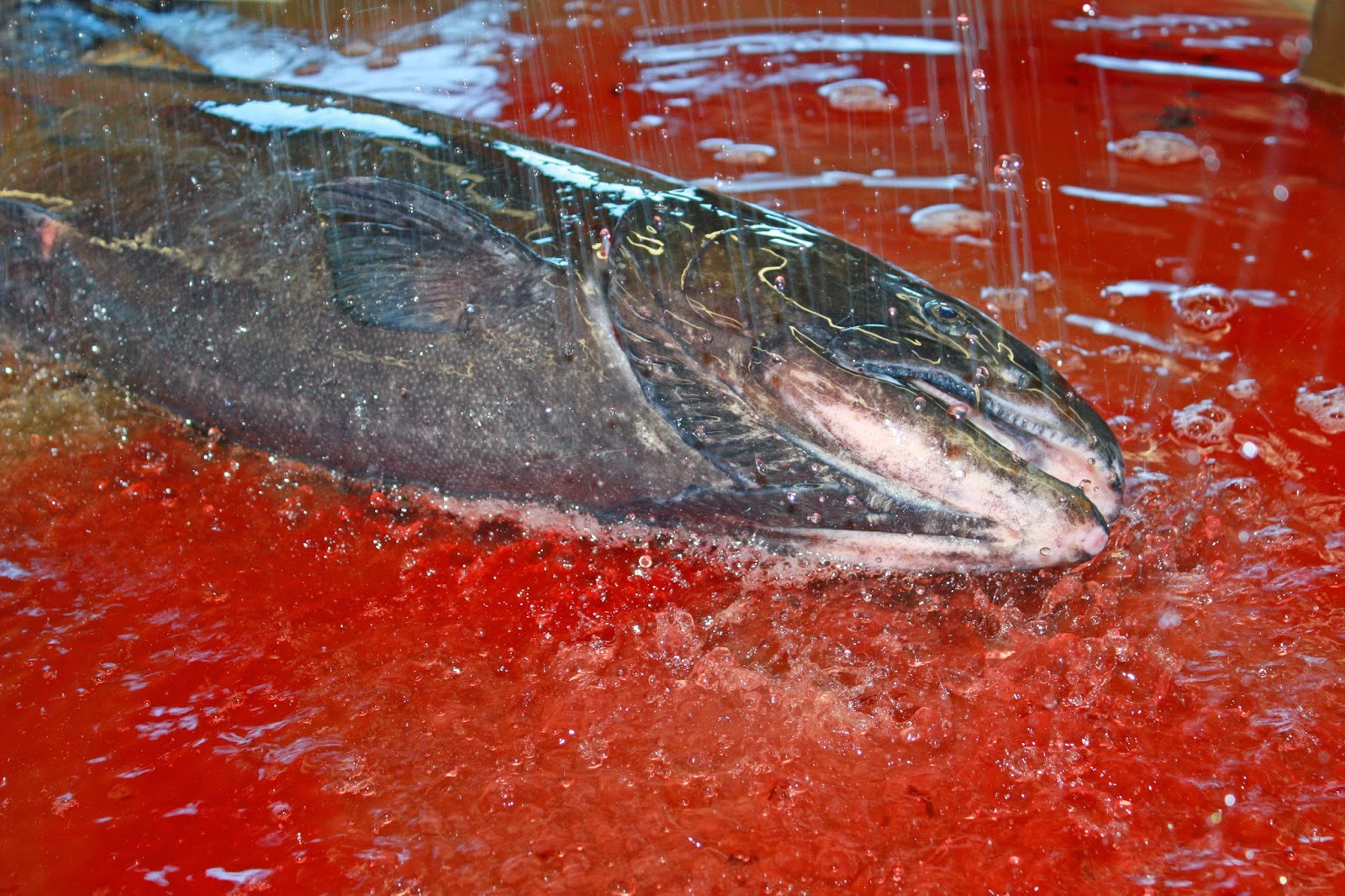
Blood in the water
Photo: Benjamin Sanford, NOAA Fisheries


Tropical Insanity

These new “secondary” forests are emerging in Latin America, Asia and other tropical regions at such a fast pace that the trend has set off a serious debate about whether saving primeval rain forest — an iconic environmental cause — may be less urgent than once thought. By one estimate, for every acre of rain forest cut down each year, more than 50 acres of new forest are growing in the tropics on land that was once farmed, logged or ravaged by natural disaster.


This article from the New York times really gets me. The gist is that due to economic conditions in the tropical countries many people are moving to the city and abandoning arable land. This land is then growing back into forest and acting as a carbon sink. Apparently, according to the article, there is a "debate" among scientists as to whether or not we should decrease our efforts to save tropical forests since these new second growth forests may be sucking up enough carbon to make up for the lost primary forest.

This is wrong on many levels, maddeningly wrong. First, I doubt that there is any serious debate on this topic. However, the news must make a story so they find some wingnut and twist his story into a debate. This happens way too often and is die in large part to the lack of qualified science editors in news organizations.

For a primer and some great pictures of the difference between primary and secondary tropical forest visit this site.

Second, there is a clear distinction, even in temperate forests, between primary (old growth) forest and secondary forest. Yes, it is true that secondary forests are carbon sinks, they may even suck up carbon at a faster rate than old growth due to their higher growth rate. However, the forest is very different. It only has one canopy, there is a marked decrease in species richness (marked being often greater than 50% fewer species of all animals, plants and birds), it is also more susceptible to fire (a previously virtually unknown problem in the wet tropics until we started cutting down the forest at the clip we have become used to). Also, it is not guaranteed to proceed into primary forest, and even when it does develop taller trees and multistory canopy it is much less diverse. Worse, some forests have a very delicate balance that, if disturbed, would likely never return. This includes things such as Varzea forest in the Amazon in which the annual flooding has induced fish, bird, insect, tree and mammal species to develop complex interrelationships. These forests will never come back the way they were if they are destroyed.

Third, who says that economic conditions won't change. Up until recently it was easy to get a job, now with the economic downturn that may change drastically. For poor peasants in the third world it is better to be a subsistence farmer than a poor, homeless bum in a city. People will begin to recultivate these areas. Large farms will probably do well. Commodity prices could easily spike again as they did last winter in the midst of the current recession. Also, commodities are fairly stable and concrete compared to other investments. I'd rather have an acre of fertile tropical soil than a $100,000 mortgage derivative investment at this point. To divert money from saving primary forest in the hope that abandoned land will stay as forest is a pipedream.

This is to say nothing of the need for species diversity. If this is ignored completely in favor of simply looking at this from a carbon balance perspective we've lost the battle. We are currently causing one of the greatest extinctions in the histroy of the world. Like it or not we are tied into the food web, the fewer species there are the less stable that web becomes. Similarly, we lose the opportunity to sustainably exploit these resources in ways we have yet to discover. The argument is tired and old but there may indeed be great medicinal value in some of the species in tropical forests. And this is all glossed over by our moral imperative to keep our world safe for our children.

I would like to know the full story on this. I doubt that there is truly a large debate in the scientific community, although I would say there is certainly a good amount of righteous indignation toward this Joe Wright guy. His position is completely untenable and lacking any long-term thinking. If we were to take him seriously we would lose one of the greatest treasures and greatest resources this world has to offer. If this story did indeed paint Joe Wright and the controversy in the proper light he is a stooge to be ignored, not a serious force in tropical science or conservation.

Back from Whence Ye Came


Salmon are pretty incredible creatures. I stopped by Spalding Park near Lapwai, Idaho (officially known as Nez Perce National Historic Park and containing an excellent museum of Nez Perce art and historical pieces reclaimed with the help of Walt Disney's wife, a native of Spalding, ID) to see the spawning Coho salmon this past week. I've never seen salmon spawning so it was an exciting moment. Watching them makes you realize that life is circular. Ashes to ashes and all that, but not in a depressing way at all.

The picture above is a spawned out female that I found while peering off the bank at a female preparing her redd. She had already begun the next cycle, the nutrients she carried from the ocean helping to keep her spawning stream healthy and productive for the next generation.

Salmon prepare a redd, or nest, in the gravel of the stream bed into which they lay their eggs which are subsequently fertilized by the male and covered. Each species does it differently. Coho are adapted to more silty areas and their redd making entails sweeping away the silt with their tails, while other species may mound the gravel more or less and choose particular sized gravel and silt levels to suit their evolutionary taste. The picture to the right show a female coho preparing her redd by laying on her side and flapping her tail to clear the silt from the gravel. The next picture shows what the redd looks like from above. The oblong patch of lighter colored gravel on the right side of the picture next to the bank is her redd. Bonus points if you can find the salmon in the picture. She saw me on the bridge and moved off her redd into the darker and more camouflaging area of the stream.

Coho were declared extinct in the Snake River and only recently have been reintroduced by the Nez Perce tribe. Lapwai creek runs into the Clearwater river at the park which is located on the Nez Perce reservation. The Park is named after Henry Spalding, a missionary from the 1800's who's grave marker is shown to the right.The park encompasses the mission site as well as the historic cemetery.

While I was there I had a bit of an epiphany about life and death. I'm not sure if the salmon were the spur to my thinking or
not.
A member of one of my classes, which centers around cross disciplinary issues of salmon recovery on Lapwai creek, is a Nez Perce Tribal member. While visiting the park earlier he mentioned that a close friend had died and that he would be buried in Spalding cemetery. I watched the grave being dug and saw it again when I returned to see the salmon.

I noticed that rather than dig the grave with a backhoe friends and family came out, peeled back the sod, and dug the grave by hand.
Regardless of your personal convictions I think most people are horrified when they learn how we bury our dead. I can say that when I die I hope I am not filled with immutable fluids and placed in an impermeable casket within a concrete box (to keep the grave from sinking as I decompose), and placed in a hole dug by some anonymous and surly city employee who will likely throw his cigarette butt in the hole when he's done.

I can only hope that I surround myself with friends and family that would see the social value in coming together to dig my grave the way it aught to be dug, by hand. I can only dream that I would be laid down in a simple pine box or shroud so that, like the salmon, I can go back from whence I came.