
For my PhD I study fish migration using the chemicals trapped in their ear bones. Think of their ear bones like the black box of an airplane…containing all the information of where they have travelled in their life and a lot about what was happening while they were there.These two sentences almost always catch peoples attention. It gets across the gist of what I do as a PhD student pretty succinctly and is sure to start a conversation. But, it misses a large part of what my work entails. First you have to get those ear bones (called otoliths), and like much of what ecologists do…it ain't pretty.
 |
| Salmon Ear Stones (otoliths) Photo: Ben Sanford, NOAA Fisheries |
Hearing about the cool things you could uncover from a profoundly disgusting job was one of the first times I considered ecology as a career, actually. After a family dinner an older relative of mine, Curt Mack, and his girlfriend, were regaling us with tales of necropsies of dolphins that had washed ashore on a Pacific Northwest beach. (Note: I have no idea how far off base I might be on the location, creatures involved, and the people who actually did the work…it was a long time ago…but it was utterly fascinating and foundational). For some reason, though the work sounded utterly disgusting, what they could determine from it was fascinating.
This fascination may have had something to do with Curt being one of those older relatives who is not quite old enough to be uncool (and who might, for example, sneak a young relative away from an otherwise tedious wedding to have a milkshake in an old-west style saloon in Northern California without telling his parents. But I digress...). Dissecting a decaying dolphin would have to rank as one of the more disgusting things anyone has ever done, but I was rapt. I should note that Curt has always been a fantastic storyteller when coaxed into talking about his work with river otters, restoring Grey Wolves to Idaho (he was foundational to that effort, adding to his older cousin awesomeness in my eyes, but he's modest), or tales of sailing adventures in California or the Caribbean. He comes by his storytelling honestly, his father Burt is an excellent scholar and writer and tells stories with a twinkle in his eye. Whether it was the strength of Curt's story, the disgusting content, or both I don't know. Still, it got me thinking hard about ecology as a potential major and career.
Every Fall I head down to Lyons Ferry Fish Hatchery near the tiny town of Starbuck, Washington, to collect fish ear bones. Whatever romantic notions you hold about salmon spawning in the wild are entirely correct, keep them. But the industrial spawning that keeps fish in our Western rivers is not at all romantic, it's a bloodbath. After fish have been killed, eggs and sperm collected, weighed, counted, genetic samples taken, and all the myriad tags have been found and recorded, I add one more gruesome step. I cut open their head and steal those two bones that hold the coded "black box" information of its life's travels.
 |
| Dissecting for salmon otoliths, nestled right below the brain Photo: Benjamin Sanford, NOAA Fisheries |
 |
| I actually broke my dissecting knife! Photo: Jens Hegg |
 |
| Otolith knife gallows humor. Photo: Jens Hegg |
As gross as it is, what we're doing is important work. We can argue all we want about the value of wild vs. hatchery fish but, at least in the Snake River, we wouldn't have Fall Chinook without hatcheries whether we like it or not. Beyond that, I guess sometimes you just have to get up to your elbows in blood in order to learn something new about how the world works. So far I've published two peer-reviewed journal articles (1 and 2) on what I've found in these ear bones, and more are on the way. It's worth embracing the grossness in ecology, seeing it for the opportunity it is. Even though this will never be my favorite activity, it's worth understanding, appreciating, and yes...even trying to see the beauty in it all.
 |
| Haunted House or Fish Spawning? Photo: Benjamin Sanford, NOAA Fisheries |
 |
| Your author at work, with a HUGE male Chinook Salmon. Photo: Benjamin Sanford, NOAA Fisheries |
 |
| Dissecting for otoliths Photo: Benjamin Sanford, NOAA Fisheries |
 |
| Snouts ready to be dissected for Coded Wire Tags which track where a hatchery fish was born. Photo: Benjamin Sanford, NOAA Fisheries |
 |
| Discarded snouts after CWT dissection. Photo: Benjamin Sanford, NOAA Fisheries |
 |
| Male Fall Chinook awaiting spawning Photo: Benjamin Sanford, NOAA Fisheries |
 |
| Two fish awaiting spawning Photo: Benjamin Sanford, NOAA Fisheries |
 |
| Yep, Blood stalactites exist, believe it or not. Photo: Benjamin Sanford, NOAA Fisheries |
 |
| Salmon eggs. Photo: Benjamin Sanford, NOAA Fisheries |
 |
| Egg in the sun. Photo: Benjamin Sanford, NOAA Fisheries |
 |
| What'cha lookin' at? Photo: Benjamin Sanford, NOAA Fisheries |
 |
| Egg collection Photo: Benjamin Sanford, NOAA Fisheries |
 |
| This knife belongs in a horror movie Photo: Benjamin Sanford, NOAA Fisheries |
 |
| The perfect spot is about an inch behind the eyes, but it's mostly learned by feel Photo: Benjamin Sanford, NOAA Fisheries |
 |
| A perfect cut makes it easy to remove the otoliths Photo: Benjamin Sanford, NOAA Fisheries |
 |
| Did you know that salmon can be actively decaying and still alive to spawn? Photo: Benjamin Sanford, NOAA Fisheries |
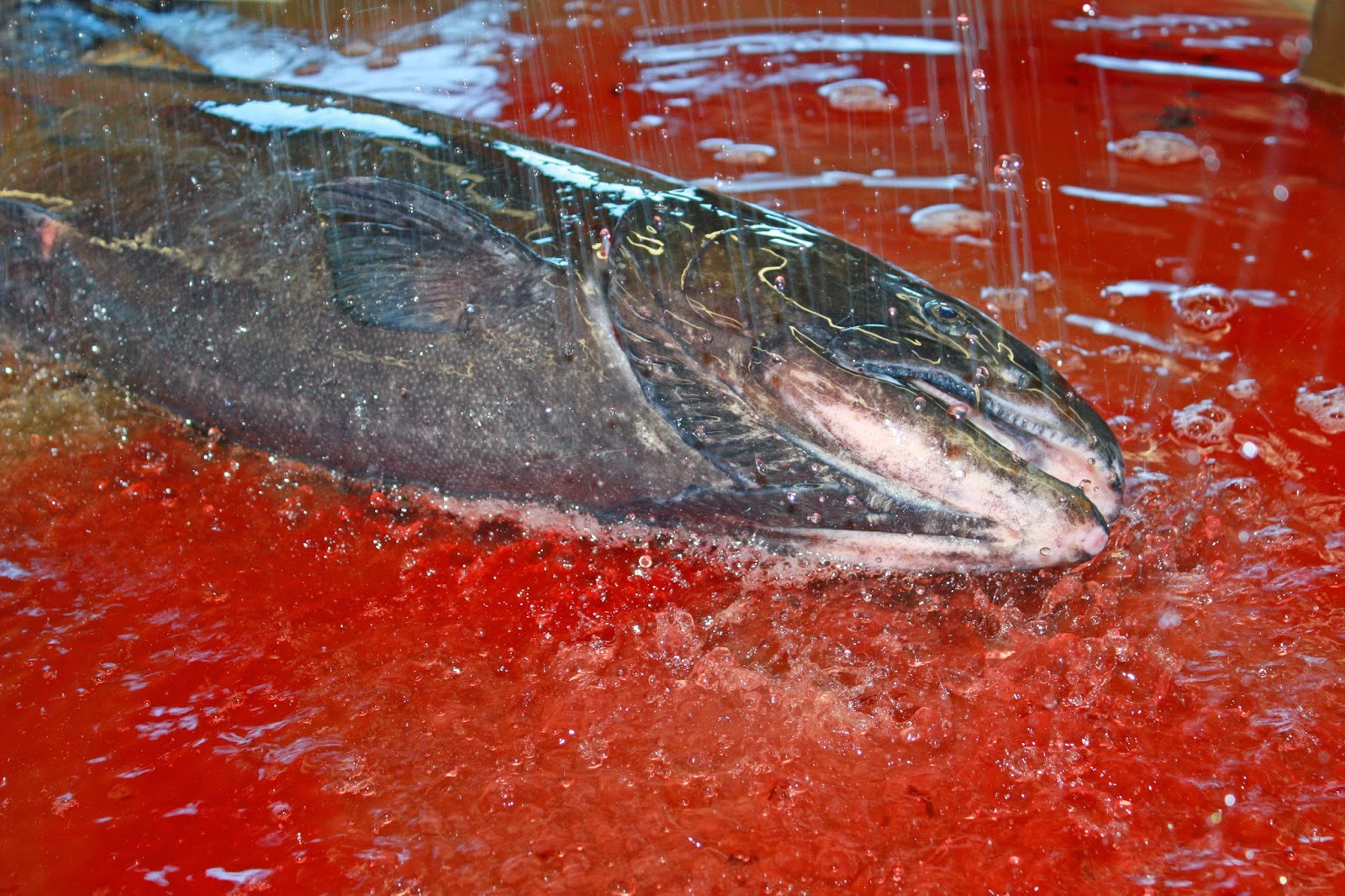 |
| Blood in the water Photo: Benjamin Sanford, NOAA Fisheries |
Labels: Academia, career, Dirty Jobs, ecology, fish, fisheries, gross, inspiration, mentors, migration, otolith, salmon, work


