Embracing the beauty of gross as a fish ecologist

For my PhD I study fish migration using the chemicals trapped in their ear bones. Think of their ear bones like the black box of an airplane…containing all the information of where they have travelled in their life and a lot about what was happening while they were there.
These two sentences almost always catch peoples attention. It gets across the gist of what I do as a PhD student pretty succinctly and is sure to start a conversation. But, it misses a large part of what my work entails. First you have to get those ear bones (called otoliths), and like much of what ecologists do…it ain't pretty.
Salmon Ear Stones (otoliths)
Photo: Ben Sanford, NOAA Fisheries
Now, to be sure, there are plenty of ecologists out there who count birds on sunny days in the wilderness, or create models in the sterile confines of an office. But, for every ecologist with a clean and sterile study area there is an ecologist who is monitoring the genetics of jaguars by walking through the woods and collecting their poop. Ecology is usually about getting your hands dirty.

Hearing about the cool things you could uncover from a profoundly disgusting job was one of the first times I considered ecology as a career, actually. After a family dinner an older relative of mine, Curt Mack, and his girlfriend, were regaling us with tales of necropsies of dolphins that had washed ashore on a Pacific Northwest beach. (Note: I have no idea how far off base I might be on the location, creatures involved, and the people who actually did the work…it was a long time ago…but it was utterly fascinating and foundational). For some reason, though the work sounded utterly disgusting, what they could determine from it was fascinating.

This fascination may have had something to do with Curt being one of those older relatives who is not quite old enough to be uncool (and who might, for example, sneak a young relative away from an otherwise tedious wedding to have a milkshake in an old-west style saloon in Northern California without telling his parents. But I digress...). Dissecting a decaying dolphin would have to rank as one of the more disgusting things anyone has ever done, but I was rapt. I should note that Curt has always been a fantastic storyteller when coaxed into talking about his work with river otters, restoring Grey Wolves to Idaho (he was foundational to that effort, adding to his older cousin awesomeness in my eyes, but he's modest), or tales of sailing adventures in California or the Caribbean. He comes by his storytelling honestly, his father Burt is an excellent scholar and writer and tells stories with a twinkle in his eye. Whether it was the strength of Curt's story, the disgusting content, or both I don't know. Still, it got me thinking hard about ecology as a potential major and career.

Every Fall I head down to Lyons Ferry Fish Hatchery near the tiny town of Starbuck, Washington, to collect fish ear bones. Whatever romantic notions you hold about salmon spawning in the wild are entirely correct, keep them. But the industrial spawning that keeps fish in our Western rivers is not at all romantic, it's a bloodbath. After fish have been killed, eggs and sperm collected, weighed, counted, genetic samples taken, and all the myriad tags have been found and recorded, I add one more gruesome step. I cut open their head and steal those two bones that hold the coded "black box" information of its life's travels.
Dissecting for salmon otoliths, nestled right below the brain
Photo: Benjamin Sanford, NOAA Fisheries
It's bloody, tiring work to lift gutted 15 to 35 pound fish all day. It is also, perhaps unsurprisingly, hard work to cut open their skulls with a bread knife (by far the best tool for the job, believe it or not). After that, extracting the otoliths is a matter of experience and finesse. They are nestled just beneath the brain in two small fluid filled sacs. I've literally done this thousands of times now. A job that first took minutes now takes just a few seconds per fish. I almost never mis-cut or lose an otolith anymore. I've done this so long that I literally wore out my otolith knife this year and had to buy another one. I'm not sure I've ever worn out a knife before. I guess there is something to be said for craft, I respect the speed of skilled butchers a lot more now.
I actually broke my dissecting knife!
Photo: Jens Hegg
Otolith knife gallows humor.
Photo: Jens Hegg
Still, it wasn't until my friend Ben Sanford from NOAA Fisheries came to help me, bringing along a good camera and an artistic eye, that I could see the beauty in the gore. I have a strong stomach and a curiosity for yucky stuff, but the endless gore of the spawning room are not pleasant. Chinook have a distinct smell, quite musky compared to the clean scent of most other salmon and trout (I bet you never thought about the smell of a fish did you!). For the first year or two just the smell alone was revolting; having associated it with the bone-tiredness, tedious and long drives to and from the hatchery, and the blood of spawning season. I've mostly overcome that. I can take a break and eat a donut in the corner without a second thought these days (Yes, they keep donuts and coffee within arms reach of my dissection station…and all of us partake).

As gross as it is, what we're doing is important work. We can argue all we want about the value of wild vs. hatchery fish but, at least in the Snake River, we wouldn't have Fall Chinook without hatcheries whether we like it or not. Beyond that, I guess sometimes you just have to get up to your elbows in blood in order to learn something new about how the world works. So far I've published two peer-reviewed journal articles (1 and 2) on what I've found in these ear bones, and more are on the way. It's worth embracing the grossness in ecology, seeing it for the opportunity it is. Even though this will never be my favorite activity, it's worth understanding, appreciating, and yes...even trying to see the beauty in it all.
Haunted House or Fish Spawning?
Photo: Benjamin Sanford, NOAA Fisheries

Your author at work, with a HUGE male Chinook Salmon.
Photo: Benjamin Sanford, NOAA Fisheries

Dissecting for otoliths
Photo: Benjamin Sanford, NOAA Fisheries

Snouts ready to be dissected for Coded Wire Tags which track where a hatchery fish was born.
Photo: Benjamin Sanford, NOAA Fisheries

Discarded snouts after CWT dissection.
Photo: Benjamin Sanford, NOAA Fisheries

Male Fall Chinook awaiting spawning
Photo: Benjamin Sanford, NOAA Fisheries

Two fish awaiting spawning
Photo: Benjamin Sanford, NOAA Fisheries

Yep, Blood stalactites exist, believe it or not.
Photo: Benjamin Sanford, NOAA Fisheries

Salmon eggs.
Photo: Benjamin Sanford, NOAA Fisheries

Egg in the sun.
Photo: Benjamin Sanford, NOAA Fisheries

What'cha lookin' at?
Photo: Benjamin Sanford, NOAA Fisheries

Egg collection
Photo: Benjamin Sanford, NOAA Fisheries

This knife belongs in a horror movie
Photo: Benjamin Sanford, NOAA Fisheries

The perfect spot is about an inch behind the eyes, but it's mostly learned by feel
Photo: Benjamin Sanford, NOAA Fisheries

A perfect cut makes it easy to remove the otoliths
Photo: Benjamin Sanford, NOAA Fisheries

Did you know that salmon can be actively decaying and still alive to spawn?
Photo: Benjamin Sanford, NOAA Fisheries

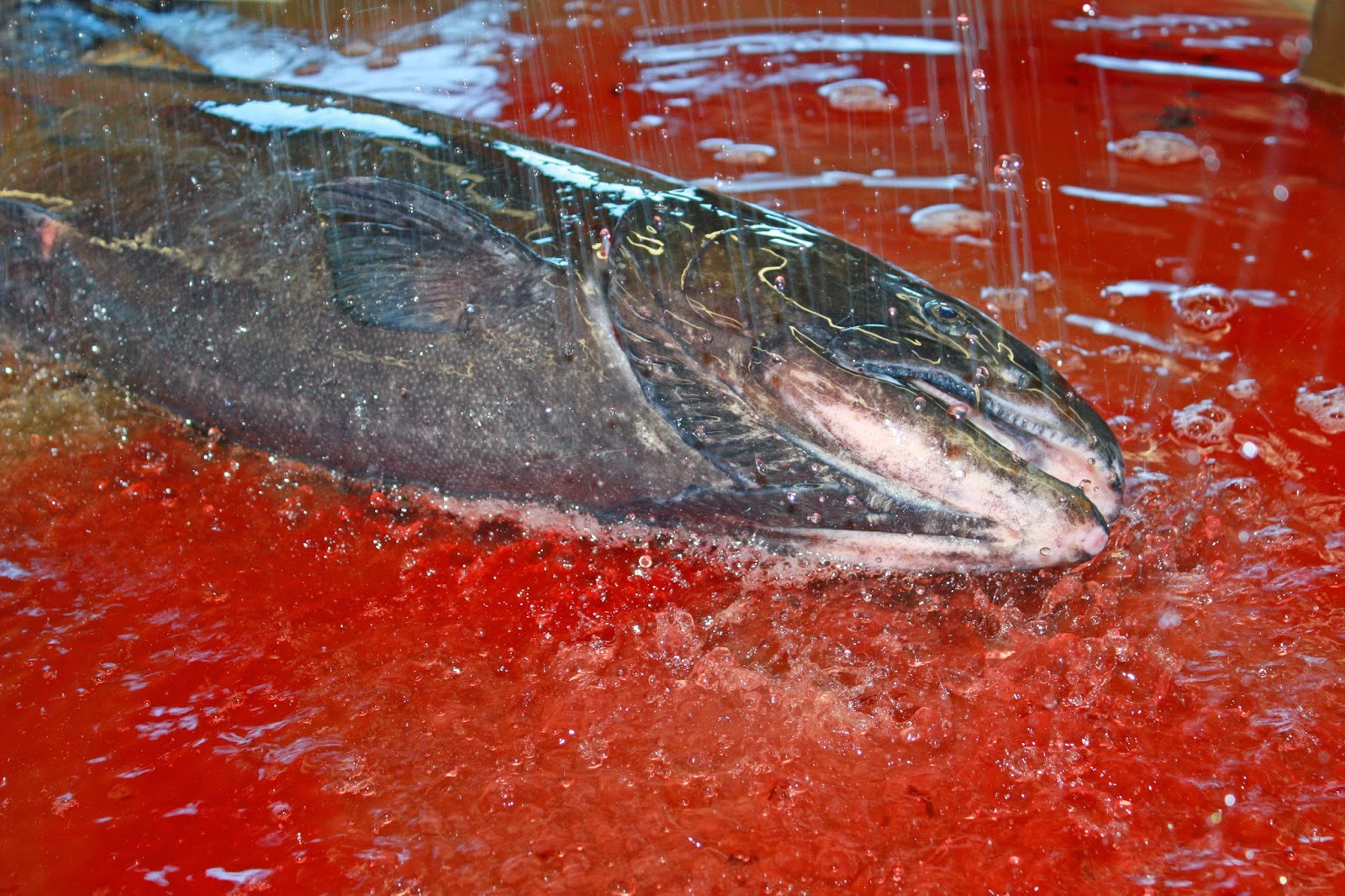
Blood in the water
Photo: Benjamin Sanford, NOAA Fisheries


On Coffee and Science Education: sometimes a millimeter makes all the difference

I'll tell you the moral to this story right off the bat. Sometimes a millimeter is the difference between something great and something terrible. Sometimes it pays to look at the details, understand why things work the way they do, and work through a problem logically. Sometimes it's fun to geek out on something, roll your pants into high waters, put in your pocket protector and act like an engineer. It might even save you twenty bucks. Sometimes I wonder if our country's lack of interest in science is partly due to our willingness to unthinkingly replace rather than understand and repair.

I recently bought a new coffee maker at World Market, a Pezzetti italian style moka pot. I did it because I thought the espresso machine I was given last year had kicked the bucket. It turns out that it's working fine again after apparently deciding to go on a short sabbatical for no reason I can determine. I was excited for the new moka pot because I just love the thick, almost syrupy coffee filled with deep caramel flavors that these little pots make. People confuse them with espresso makers but they really excel at the bottom end of coffee taste. Moka coffee usually lacks most of the high, bright, citrus notes in espresso. Both are good but they are very different animals. But I digress...

I filled the new pot with coffee and water and put it on the stove anticipating a stout cup of coffee. It boiled…and boiled…and boiled some more with steam coming out the top tube before it started spitting a tiny bit of extremely thick black coffee out of the collection spout. Then, after a few tablespoons it just quit and started making sputtering, spitting noises and smelling like the worst church-basement-percolated-through-a-two-hour-sermon brew you can imagine. That two tablespoons could have been mistaken for motor oil mixed with paint stripper. In a word it was undrinkable. I tried again a few days later and the result was the same.

I'm wasn't very familiar with these things, but the idea is pretty simple. Build up vapor pressure in the base, which forces the hot water up a siphon tube, through the grounds and into a collection chamber at the top. It's like a cross between a percolator and a pressure cooker. Take a look at this awesome video for a bit of geeky imagery of this in action filmed with neutron imaging. This isn't a complicated machine, so what was the problem?


I couldn't immediately see a problem when I took it apart. The seal and all the filters were fine. I ended up putting it away but I kept thinking, "this is too simple for it not to work when all the parts look right." My mind kept churning on it off-and-on before I realized what had to be happening. If no water was going up the tube then somehow it was losing the vapor pressure in the bottom chamber, since that is the force that sends the water upward. But how was that happening if I couldn't see or feel a leak on the outside?

Top rim is a millimeter or so higher than the filter basket
Then I remembered that steam had been coming out the top for quite awhile before any coffee came out. So, steam was somehow getting out around the filters inside. I went to look at the seal again and happened to notice that the top rim of the bottom half of the pot was slightly higher than the filter that fits inside it and holds the coffee. It was only a millimeter or a bit more, but perhaps that distance was too much for the rubber seal to bridge, letting steam out around the edge of the coffee basket. Hmm…

grinding down the rim on a water cooled lapping wheel
Over the next week I dropped into a couple of stores to take a look at their moka pots. Sure enough, all of them had rims on the bottom chamber that were the exact same height as the filter basket. It was time to experiment. I loaded up the coffee pot with water and grounds, then tightened it as hard as I could to, hopefully, create a better seal. It didn't really work, but I did get about twice as much motor oil/paint stripper solution out of the pot this time around so i figured a better seal must be helping.

Luckily, I had an easy way to fix the problem. I took the pot to my lab and ground the rim down with the sandpaper on a lapping wheel. You could do this easily enough with sandpaper mounted to a board, but a lapping wheel takes less time and the water jet helps keep things cool. You can see from the picture that the rim matches the height of the filter basket now after just a minute or two of grinding.

Rim even with filter basket after grinding
Then came the moment of truth. I loaded the filter basket with freshly ground Indonesia Gajah Aceh from Stumptown, filled the bottom chamber with water, and put it on the stove. This coffee is already just full of deep, intense, earthy flavors…my mouth was watering imagining how rich this coffee would be. I hoped I wasn't going to be disappointed yet again.

It worked! No steam came from the tube in the center of the collection pot, instead a steady stream of coffee issued forth with no sputtering or spitting until the pot was full and the water chamber was empty. The coffee was awesome…and is fueling this late night blogging session as we speak; thick, rich and chock full of bitter chocolate, carmel and straight up dirt.

Sometimes it pays to work through a problem like an engineer, understanding how things work and the principles behind it. I think too often now days we would rather buy something new than fix what we have and that is a shame. My grandfather used to spend lots of time tinkering and fixing things, and creative repair is a daily occurrence for my father the wheat farmer. Watching them taught me that if you understand how something works you can usually fix it or improve it. That is the essence of engineering and science.

Perhaps we Americans have so few kids interested in science because we aren't teaching them how rewarding it is to observe, troubleshoot, and creatively repair things in our lives. You can't learn that skill if you throw things away every time they don't work. Which reminds me…maybe I should figure out why that espresso machine decided to quit turning on for two weeks and then fixed itself for no reason. I'll keep thinking on that one while I try desperately to finish my PhD. Until then, my advice is to avoid moka pots from World Market unless you want to repeat what I just did.
The moment of truth. A perfect brew with no sputtering!

Pipe Shelf Entertainment System

I've actually had these shelves up for a couple years, but it was just recently that I finally took the time to attach the speakers. Pipe shelves seem to be all the rage and I have to say they look pretty classy, hipster, and rustic without breaking the bank. If you happen to use mason jars for drinking glasses and own a few chickens, or live in an industrial, exposed brink loft, these will fit right in!


I made these with the idea that they would be an addition to our "entertainment system", if you can call it that. We mostly watch Netflix and other streaming stuff on our Apple TV. I'm a bit of an audiophile though and I always have to have good sound, especially for music. To that end I bought a pair of Alesis Monitor One Mk II speakers when we moved into the new house. To maximize useable space, rather than have them sit on the table I designed the shelves to hold the speakers. The screen sits on top of the stereo receiver on the table below. Being a lazy git, it took me way too long to get around to actually mounting the speakers.

The shelves are made from 3/4" iron pipe and they are extremely easy to make. The shelves themselves are drilled so that the main pipe supports go through them in the front and the wood rests on a T fitting. The t-fitting extends to the back of the shelf with a short length of pipe and a 90-degree fitting supports the rear of the shelf. Each support section is screwed to the wall with base plates at top and bottom.

The speakers are held by separate base plate fittings added to the bottom. Screwing into the side of the speakers kindof made me cringe, I hate to put holes in such nice speakers, but the result was absolutely worth it. They look classy and actually sound better this way as well.

Sitting on the table they sounded pretty stunning, but suspended on the shelves they now sound noticeably better. Because the table is just about the same height as your head when sitting on the couch I think it was reflecting a lot of sound upward, either creating cancelation or just reflecting it upwards and cutting out some of the sound spectrum. Now that they are suspended they sound more full, even and crisp. I was actually amazed at the difference in sound quality.

The shelves are easy to build. I spend some time drawing out what I wanted based on the wall space I had available. The biggest hangup is to make sure you measure twice and drill once on the shelves. I screwed up the hole location on one board and had to throw it out. Make your holes a 1/4"-1/2" bigger than the pipe so that there's some slack, especially if your house is as crooked as ours, otherwise things will get hard to fit together. Attach the bottom base plates and build the shelves upward and finally screw in the top baseplates. Having a spirit level handy (I used the one on my iPhone) is essential. If they pipes are at all crooked it's very obvious!

I used raw iron pipe because I liked the look and it was way cheaper than galvanized. If you do the same, make sure to wash each pipe really well. It comes covered in oil that will get all over everything it touches. You have to scrub the pipes with a plastic brush and plenty of detergent to get it off. Let it air dry or dry it with a cloth. Don't let it sit around wet or you'll end up with rust…which might make a nice patina depending on what you're going for.

It wasn't particularly cheap, even though it seems like it should be. I spent about $100 on the pipe, the boards, stain and varnish would have been more but I already had them from some other shelves I got rid of. So, unless you can find a source of used or reclaimed pipe it can get kinda pricey. It won't beat Ikea but it's probably less than shelves at a furniture store, and better looking.

If you mount speakers pay attention to how close they are to the wall. If they are rear ported you can create really strange harmonics and/or muffle your speakers if those ports can't move enough air. If they are front ported or closed you can mount them right against the wall. My speakers have rear ports. I was a bit worried about mounting them so close to the wall but with about one and one-half inches of space they don't show any strange harmonics or other port noise even at pretty loud volumes. We never use them too loud anyway, so they probably aren't moving enough air for it to be an issue.

I've been incredibly impressed by these speakers so far, especially for acoustic music. They reproduce sounds that I've only been able to hear in high-end headphones. For instance, the Wailin' Jennies "Firecracker" is one of the best produced albums I've ever heard and on these speakers the instruments and voice mixing is so much fun to listen to, especially the mandolin, that I could listen for hours. You can clearly hear the placement of each instrument and voice in stereo-space and incredible nuances of the sound of each instrument jump out at you.

The MkII speakers are marketed to audio engineers as studio monitors, not to the home audio market. They have been extremely well reviewed by audio engineers and many people think that they perform well above their $200 price tag, hanging with the big dogs in terms of flat frequency response and crisp reproduction of sound. Depending on what you want in speakers this is either great or terrible for home audio. Some people prefer softer edges on their sound and super flat frequency response sounds too crisp and snappy to be enjoyable. But, companies like Klipsch have been making lots of money on extremely crisp sounding speakers for a long time, so depending on your tastes this isn't all bad.

I love them, but for people who tend to get fatigued by that level of crisp detail they might not be the best choice. Still, to my ear, they don't sound as unapproachable and harsh as some of the really crisp sounding Kliptch speakers and they are much more musical than a lot of hardcore studio monitors. For $200, or a lot less used, I doubt you could find better speakers even at double the price. Suspending them with a shelving system like this also really lets them shine.


Fear in the Field: Now is the time for the fisheries field to act.


A mixed group of fisheries field workers - Gary Peeples/USFWS

"If not me, who? If not now, when?" - Emma Watson, UN General Assembly, 2014 
As a male graduate student I rarely have to think about gender issues, at least not in terms of their affect on me directly. Still, I have a fiancé who is a professor in geology, a sister who spends plenty of time abroad for her work, and numerous women in my lab and department. It doesn't take long to hear stories about how gender affects your experience as a scientist, how comments about appearance or femininity undermine confidence, or how double standards often surround the expectations of female scientists.

I have seen this, and dealt with the fallout of these gender issues fairly frequently. Still, it appears that there is a large segment of male scientists who don't get it. The same problems seem to persist year after year and I rarely if ever hear anything about it from those in authority. When I do it's invariably vague and comes without any concrete action. With Emma Watson's excellent and moving speech before the UN last Saturday there has been a groundswell of media coverage surrounding her statement that gender equality is everyone's problem to solve, most positive and some proving her point.

Those of us in field-based sciences face some very specific gender related issues to solve; problems that have been put in stark relief by another recent event, a paper released in July in PloS One showing that field research can be a forbidding and abusing experience for trainees. The abstract of this recent paper in PloS One by Clancy et al. should be shocking to scientists of all genders:
"...harassment and assault were commonly experienced by respondents during trainee career stages. Women trainees were the primary targets; their perpetrators were predominantly senior to them professionally within the research team. Male trainees were more often targeted by their peers at the research site. Few respondents were aware of mechanisms to report incidents; most who did report were unsatisfied with the outcome." - Clancy et al., 2014
Most of us who work in fish ecology, or natural resources in general, are here because we fell in love with working outdoors, in the field. We all have memories of great times with new friends at field sites during college courses, summer internships, or technician positions. These are often the formative experiences in our pursuit of this as a career. But this graphic from the paper indicates that more than half of the women, and a good share of the men, I've been in the field with haven't had such a great experience.

To me this is shocking and disturbing, especially knowing that fisheries is dominated by white males and already has a problem with diversity. A quick search of the American Fisheries Society monthly magazine "Fisheries" shows that there are a few articles related to women in fisheries, but the most recent are spotlights of the prominent females in the field and discussion of more philosophical approaches to including female perspective in fisheries writ large.

There hasn't been a pointed discussion of the inherent problems that field-based fisheries research creates for women. I haven't, for example, heard a peep out of my own department about this. This could easily be because it hasn't been visible, but with the Clancy paper including almost 50% of it's respondents in biological and other related sciences this can't be ignored. I feel like it requires a concerted response, and not just another online sexual harassment training. It cuts directly to the core of the culture of field work in a way that needs to be addressed by the field at large as well as university departments and government agencies.

Most undergraduate programs require some sort of internship or field experience to graduate. At University of Idaho an internship is required and many students take part in summer field experiences with faculty researchers and government agencies to fulfill this requirement. This means that UofI is requiring students to take part in field experience that, if this paper can be generalized, is exposing women undergraduates to harmful interactions. Further, these experiences are often outside of the control of the University; students might never spend enough time with their employer to fully understand how to report inappropriate behavior and yet reporting through the University might not result in any help. Even if mechanisms are in place at the University they may be hundreds or thousands of miles distant, effectively useless aChristie Aschwanden makes clear in her essay in the New York Times
"Reflecting back, I’m struck by how ill equipped I was to deal with this kind of situation, especially at 19. My university undoubtedly had a harassment policy, but such resources were thousands of miles away. I was alone in a foreign country and had never received any training on my rights and resources in the field."
Remember, not only did the paper show that harassment and assault happens, it showed that the ability to report it is often not even there for victims and when it is the results are poor. It's time for departments, agencies and individual labs to step up, take charge.

I know from my experiences that fieldwork tends to have a loose, relaxed vibe. It's a time when we can get out of the office and into the field, away from the strict expectations of office work. There is usually plenty of time for socializing after a long day of work. Depending on the work there might be alcohol around a campfire or at a local watering hole. It feels more like a camping trip than a job sometimes. But, as the superiors of (often younger) students we need to realize that it's not ok to adopt the, "what happens in the hunting camp stays in hunting camp," mentality. Lets face it, that mentality isn't healthy even in most hunting camps we shouldn't expect it to be healthy on the job. This is a job, and for the undergraduates and graduate students this is a necessary route to a career. We need to understand and respect the power dynamics at play in the field. We also need to explicitly clarify how to report problems and then make sure that reports are followed up and those who break the rules get punished.

A recent article entitled "Science's Sexual Assault Problem," by A. Hope Jaheren in the New York Times both sums up the problem well:
"I listen to my colleagues talk endlessly about recruiting more women into STEM (science, technology, engineering and mathematics) disciplines, and postulate what the barriers might be. Sexual assault is a pernicious and formidable barrier to women in science, partly because we have consistently gifted to it our silence. I have given it 18 years of my silence and I will not give it one day more."
It also provides a sobering reminder of what it means if we don't act and fix these problems and instead decide to sweep it under the rug. 
"In August, Lego began selling a set called “Research Institute” that features three female scientist minifigures: a paleontologist, an astronomer and a chemist. I am well qualified in two of those fields, and I am here to say that playing with a different set of dolls will not adequately prepare your daughters for a career in science. You must teach them, rather, to manage their dreams. They need to know that daring to act upon their dreams of science can be both a beautiful and a dangerous thing."
I, for one, don't like the idea that anyone should have to manage their dreams. The very idea disgusts me. I hope the rest of my peers feel the same way and are willing to speak up and pro-actively do something about it. 

This article shows that just because there haven't been any reported incidents of harassment or assault reported to supervisors doesn't mean it isn't happening. We can't wait until something happens, because it is already happening, we just don't have the tools or culture in place that lets the news get out. We need to act decisively, vocally and openly to make sure that everyone can enjoy their field experiences. Nobody should ever have to balance a future career against the despicable actions of their superiors in the field. I think Christie Aschwanden gives us something to aspire to.
"It will take chief executives, department heads, laboratory directors, professors, publishers and editors in chief to take a stand and say: Not on my watch. I don’t care if you’re my friend or my favorite colleague; we don’t treat women like that."
As Emma Watson made clear, gender equality affects all of us and all of us must stand up and make it right. There is already a nascent conversation in fisheries and natural resources surrounding the need for more female perspective in our data and in our field, and there is a much broader conversation across the sciences as a whole. Clancy et al. make it clear that it is high time to ensure we aren't driving away that positive perspective through willful blindness of what happens in the field.
“How can we affect change in the world when only half of it is invited or feel welcome to participate in the conversation?” - Emma Watson, Emma Watson, UN General Assembly, 2014
Clancy et al. are showing, in cold, hard data, that we may indeed be driving away a very large percentage of entry level women in field-based sciences like our own. Other professional societies have led the way, and I would like to see my fields do the same. The Southeastern Archeology Conference has done a self study which shows much the same results as Clancy et al. and is drafting clear field policies for members to follow. The American Geophysical Union and American Anthropological Association have issued strict policies. Closer to my own field, the Ecological Society of America will host a panel discussion at the upcoming meeting in Baltimore.

Meanwhile Fisheries, the monthly publication for the fisheries field, has mentioned gender discrimination only a handful of times over the last decade and has neglected to respond to this study at its meetings or within its covers. Its time for all of us to stand up and make clear that we won't stand for any mistreatment of women and trainees, in any form, in fisheries sciences.


Here is the entirety of Emma Watsons speech, introducing the He for She Campaign for gender equality.

Chocolate Covered Ground Cherries

This blog is rapidly becoming a foodie blog. I haven't even been posting mixed drinks the way I expected, let alone anything about my graduate program. But, this is one of my fall favorites and now that it's in season I thought I would share it.

Ground cherries are a relative of the tomato and tomatillo, but they are sweet and non-acidic. They don't taste like cherries, more like a burst of sugar and warm flavors without much tartness. They have a bit of mango and pineapple in there, but the taste is much more earthy. They are a bit vegetal, which turns some people off. Every year my grandmother eats a couple while telling me, "I'm just not sure I like them very much," which I think is kindof funny in an endearing way.

Ground cherries were once a staple of the American garden and there are numerous recipes for ground cherry pie online, along with many others. They apparently grow like weeds, much like their inedible cousin the chinese lantern, which made them a good choice for people who relied on their gardens for food. I planted a few of the fruit this year so we'll see in the spring how they grow. My favorite recipe, and one I haven't seen online, is to dip them in chocolate. With the husk pulled back into a little papery shuttlecock it makes an ideal way both to dip them and to eat them as finger food, not to mention that it's a really attractive looking dish that always gets comments.

Preparation couldn't be easier. Carefully peel back the husk and pull it backwards. It will naturally fold into a little tail. They are attached to the berry pretty tightly so they won't pull off too easily. The best berries are the ones that are golden in color. The greenish ones (as long as they aren't too green) are also sweet but have more planty taste.

Melt some chocolate in a double boiler. Really dark chocolate tastes best, it adds the right bitterness to fill in the profile. Ground cherries don't have a whole lot of complex flavor, so it's nice to have that bold bitterness of dark chocolate to fill things in. I could also imagine that orange infused chocolate like Alter Eco Dark Twist would be pretty amazing. If you haven't tried Alter Eco chocolate yet you are missing out, it's just incredibly flavorful and some of the best chocolate I've had. If you want the chocolate to look shiny you need to add some paraffin to the melted chocolate, otherwise it cools to a matte brown. The pictures here are of two batches, one with a bit of paraffin and one without.

 Once the chocolate is melted start dipping the ground cherries in. Putting them on the shiny side of aluminum foil will make it easier to get them off, the chocolate tends to stick down hard on a plate. You can peel them off and put them on a plate later. Put them in the fridge to cool, or just leave them out to cool. Once the chocolate is hard it's ready to eat!

Have fun.

Stuffed Squash Blossoms: the best of summer eats

Squash blossoms are really underrated in the US, usually relegated to Mexican food like squash blossom soup or in quesadillas. It's too bad. They taste really good and are a great way to keep your zucchini plants reproductive efficiency from taking over your life. 

I discovered stuffed squash blossoms several years ago and look forward to the time of year when I can pick a handful of big blossoms, stuff them with chevrĂ©, and make one of my favorite appetizers. As is the norm for me, I rarely use a recipe so if you want to make them you'll need to rely on some instincts and frequent tasting rather than measurements…more after the jump.

Here's to vacations!


The life of a PhD student feels a lot like this picture sometimes. It's a slog, and sometimes you feel like you are getting nothing done at all. That is both the blessing and the curse of an open ended job where, in a lot of ways, I make my own schedule and get to determine what questions I ask. But when things feel like a total slog sometimes it helps to get away.

We took a vacation to Seattle to visit some of Katie's graduate school friends who were coming up from Texas to see the Emerald City. We picked up Berlyn from his mom's, where he has been visiting for the last month, walked around Pike Place Market, explored Bainbridge island, and generally had a good time. The weather was great and the mountains were out. The sunsets over the Olympics were awesome.

Now that the weekend is over it's back to the grind. A high school student is helping out in the lab for a couple of weeks and amazingly we got a ton of work done today. I feel like I lifted out of a midsummer slump and the mountains of work don't seem quite so horrible. Here's to vacations!